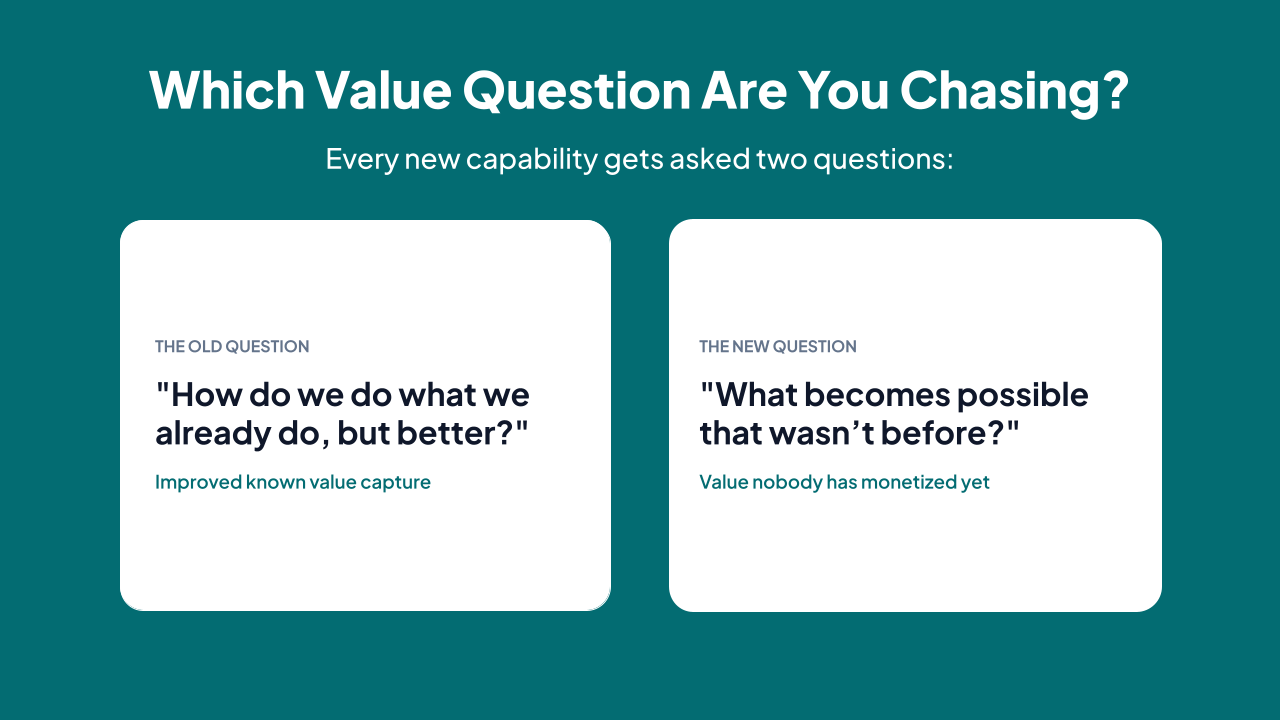
“If I had asked people what they wanted, they would have said a faster horse.” Whether Henry Ford said it or not, what this quote describes is playing out in AI right now. Companies cutting headcount for cost savings, founders building cheaper versions of products, buyers picking AI vendors on token price. All of it is answering the old question: how do we use a new capability to do what we already do, but better?
In 1876, Western Union asked: how do we send more signals through the same wire? Elisha Gray and Alexander Graham Bell both solved it — and both realized the same trick could carry a human voice. Gray stuck to the old question. How does voice compare to telegraph? Slower, shorter range, no existing market. “Of certain scientific interest but is of no commercial interest at the present time,” he wrote to his patent attorney. Bell asked a new question. What if anyone could talk to anyone, anywhere, in real time?
When Bell offered Western Union his patent, they made the same call as Gray, labeling it “a scientific toy.” By the time they changed their mind, Bell had phones in the field. Western Union threw everything at catching up but it wasn’t enough. In 1879 they surrendered their telephone business. Bell’s company became AT&T.
A century later, AT&T asked McKinsey to forecast cell phone demand by 2000. McKinsey answered the old question, extrapolating from landlines and mobile phone specs at the time, and projected under 1 million subscribers. The actual number: 109 million. AT&T largely sat out, then paid $12 billion to buy back in.
Gray, Western Union and AT&T all answered the old question correctly — and missed the new value. Because the question itself needed replacing.
AI is the sharpest tool we’ve ever had for improving known value capture. It’s also the best shot we’ve had in decades to surface value nobody has monetized yet. How are you splitting your time between these?