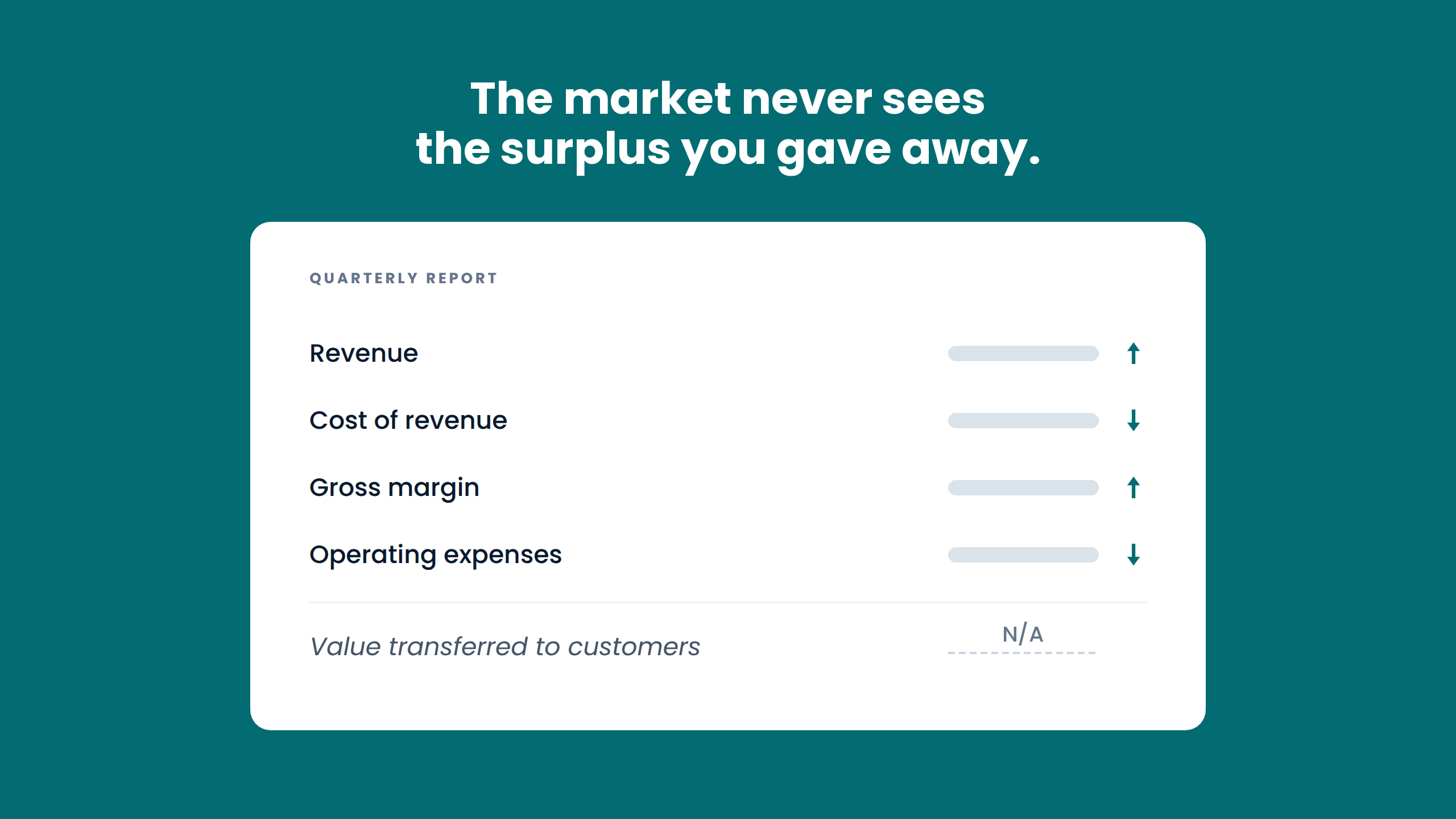
Most application vendors that shipped AI capabilities in the last three years made the same tradeoff. Few acknowledged it.
AI arrived differently from past capabilities: unproven, hard to measure, shipped inside products customers already owned, not sold separately. It delivered old work faster and cheaper, and new work nobody would have done at the old cost. Neither gain stood behind a pricing meter, so the invoice never changed.
Customers got far more out of the same products at roughly the same price. More value for the same money is surplus, and over three years it grew fast. Nearly all of it went to the customer.
Vendors kept revenue, kept customers, and stayed on the shortlist as the market sorted software into AI and not-AI. What they gave up was harder to see: the cost of running AI landed on their own P&L, and they told the market it was the future, available today.
Little of that was optional. The market wanted capability now at a predictable cost, and buyers capturing surplus on a commoditizing input is normal economics. What vendors did choose was how loudly they sold it: the work was extraordinary, and they described it the way the room wanted to hear it. Rational then, consequential now: customers expect all of it included.
That was the grace period. It held because the value was uncertain and adoption was low. The grace period is over. AI works well now. Adoption is real. The buyer surplus is still growing and still not on the invoice. Resetting price expectations is hard: even at the model layer, where pricing power is greatest, mighty Anthropic scrapped a scheduled 50% increase three weeks before it landed.
None of that makes the surplus a debt. A vendor repricing to recover it will find the market that forced the giveaway is unwilling to give it back. What has to change is the expectation, not the price.
The expectation is not just that AI powers the product. It is that the vendor keeps assuming the cost risk. Application customers can consume more tokens and owe the same. Vendors set that expectation themselves, and unwinding it is a different question — one worth its own answer.